
It All Clicks- Echolocation
Sisi always hated reaching the minefields on these expeditions, and it wasn’t because of the mines. As an ayeman ranger, Sisi was indispensable up to this point. Unfortunately, once they passed this point, they’d have no need for her and would part ways.
Truthfully, Sisi would love nothing more than to be rid of these men, save for the small problem that they still owed her money, money that they would refuse to part with once she became ‘dispensable.’
Hurry it up and map it out already!” The smallest man hissed, shivering against the morning breeze. Sisi held up her ayeman staff and pounded it into the ground. Her long ears flicked side by side, catching the gentle thrum through of the ground followed by the telltale shiver of metal struck by the wave. Each felt like a gentle ting in her ear.
“There are certainly mines here,” Sisi said as the tings came back to her, filling out the special map within her mind.
The expedition’s leader nodded. “Right then. Tell us where to walk with your map.”
How did every expedition head have the same script for this same moment? Sisi shook her head. “You’ll pay up now, or there’s no map. I’ve done this job for too long to know the patterns. You people will wait until we’re on the other side, mark the path you took, and then refuse to pay me. You know I have no leverage against the thirty of you combined. You pay me, I give you the map, and then we’ll both be on our way. No drama, no violence, just two business folk doing honest business.”
The leader glared at Sisi. “…We can pay you half now, and then half on the return.” He offered finally.
“Then you’ll get half of the mine locations now, and half on the way back.” Sisi smiled and held out her palm. Cold coins clinked into it. “Good choice, sir.”
It’s a funny story how I ended up writing about echolocation this month. I was tutoring a young student in physics when we stumbled upon waves. The student began asking all about echolocation when we were discussing wave properties. It then led to a very deep rabbit hole of clicking from one article to the next as we both discovered how vast the research of echolocation truly is.
As I drove home from that tutoring session, it dawned on me that I couldn’t think of an ancestry in any of the fiction I consumed that effectively utilized echolocation for characters. Elves don’t use it, dwarves don’t use it, you name it.
Who knew teaching middle school physics could be so inspiring?
I also don’t think it’s surprising that we don’t see character ancestries use echolocation. We humans are incredibly visual, and when we’re creating fictional ancestries or characters, we don’t really think about ways to interpret the world beyond sight. Not that it’s impossible, but we have that bias when we’re creating fantasy creatures.
In the real world, multiple species have developed echolocation for hunting and traveling: bats, whales, dolphins, shrews, ollibirds, swiflets, dormice, tenrecs, and aye-ayes. While we won’t be able to explore how echolocation works in all animals (sorry rodents!), we can still cover a lot of ground with the species we do have time for!
Make Some Noise for Sound
Let’s rewind for a second and revisit some old physics concepts: sound.
Remember that sound comes from air molecules being disturbed. There is a pulse of energy that shifts the air molecules forward, making those molecules crash into the molecules before them, and then you have the domino effect that is a “sound wave.” The best way to visualize this is to look over a pond and watch how the waves ripple. You’ll notice the waves move forward, can be further or farther apart from one another, and can bound off the pond’s edges or random stones.
(I should note that sound waves are longitudinal waves and not transverse waves, which are what water waves are. If you want a truly accurate representation of sound waves, take a slinky, lay it straight on the ground, and move one end in and out. Don’t wiggle it side to side— that’s a transverse wave. If you’ve done it right, you’ll see the “chunks” of wave move up the slinky, making our longitudinal waves. Anyhow, the important bit from the pond example is that the waves bounce back when they hit something).
Echolocation is the use of those sound waves bouncing off surfaces to perceive one’s surroundings. How a creature makes and perceives these soundwave patterns depends on the species, as we’ll see below.
Let’s Chat about the Bat
The fact that we don’t have more bat-flavored fantasy creatures and ancestries is criminal, in my opinion. Bats are fascinating creatures and are the only mammals that can fly. I’m currently reading “The Genius Bat” by Yossi Yovel, which has an entire chapter on bat echolocation. It was by studying bats that Donald Griffin discovered and named echolocation in the 1930’s. It was while reading “The Genius Bat” that I discovered that not all bats use “biosonar,” which is another name for echolocation.
Bats produce ultrasonic noises that can reach up to 200 Hz. What’s a “Hz”? It’s how we measure sound frequency, meaning “vibrations per second.” Within 1 second, bat can produce up to 200 sound waves. That many frequencies together in such a short amount of time is what allows bats to glean so much information from the soundwaves that ricochet back to them.
How do bats interpret these soundwaves once the waves hit their ears? Turns out, it depends on the bat. Bats in the Yangochiropteran suborder (which includes most micro bats) have unique inner ear structures that allow them to have WAAAAY more neurons than a normal mammal would have to translate soundwaves. The other suborder of bats, Yinpterochiroptera (which includes bats like the fruit bat), has fewer neurons and a slightly different structure within their inner ear that’s similar to those of other mammals.
So you don’t need drastically different inner ear structure to perform echolocation? Interesting…
Clicking About with Dolphins
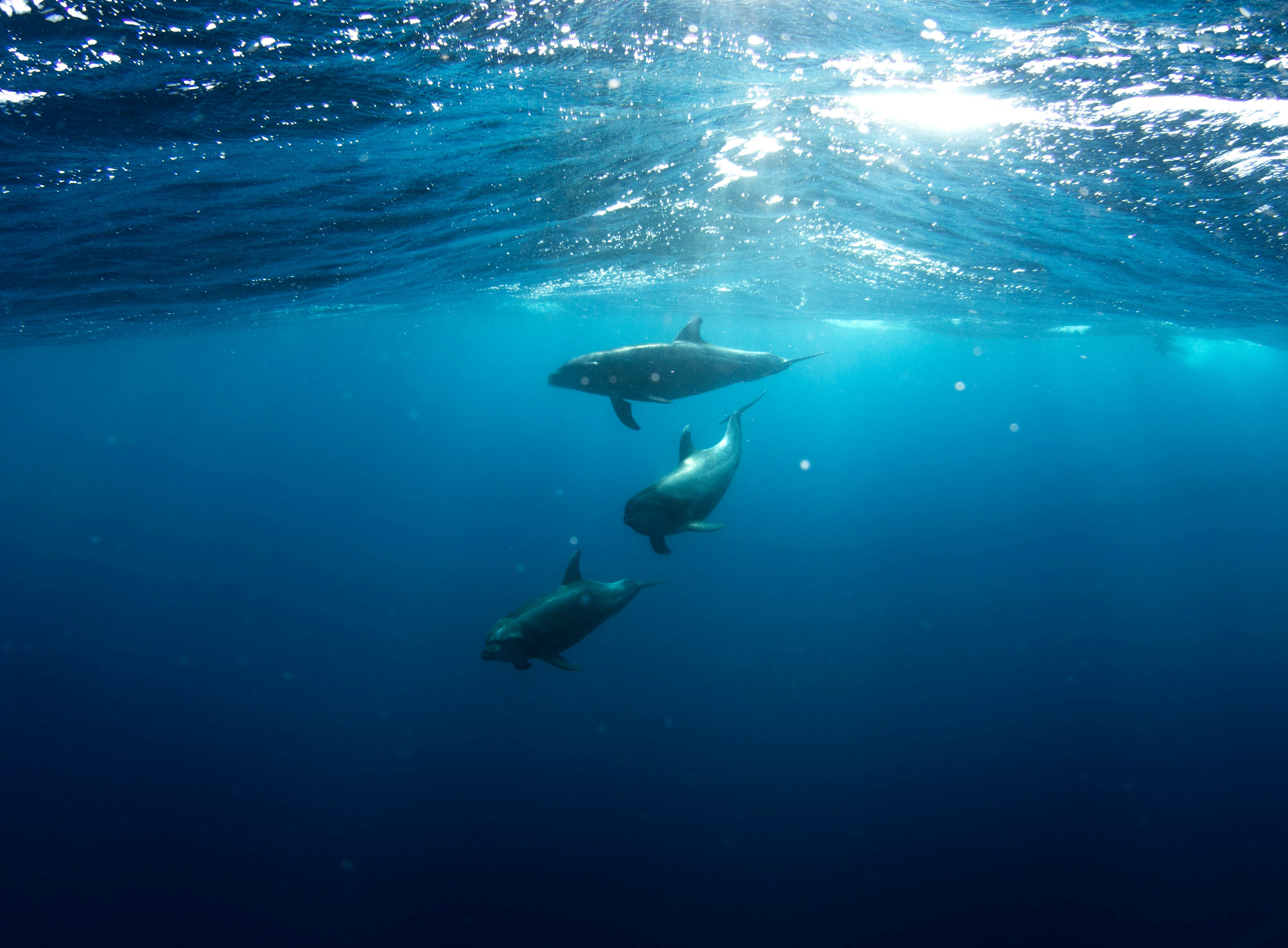
Now we’re playing in water, which changes the soundscape drastically. Water is much denser than air, which means that sound travels faster and farther. Therefore, it makes sense that the toothed whales (dolphins, belugas, dolphins) would have a slightly different way to interpreting those soundwaves compared to any of the other animals on our list.
Toothed whaled have evolved a special organ that helps produce their echolocation clicks. At the front of the whale’s head is a structure called the melon. In that melon is actually a mix of waxy compound and fats, which together are called acoustic fats. Behind the melon and beneath the blowhole is a structure called “monkey lips” or “phonic lips,” which produce the clicks we all know and love from dolphins and whales. Think of them as the toothed whale’s vocal cords. The clicks move through the fatty melon and then out into the surrounding water. The returning soundwaves are received in the lower jaw of the toothed whale, which also has a layer of fat clusters around the bone.
Can Humans Use Echolocation?
The answer is “yes, but we’re still figuring out how it works.”
This paper here discusses multiple parameters of echolocation in blind human subjects. These include loudness, repetition pitch, and sharpness (an aspect of timbre that we can’t dive into for this post). Blind echolocators produce a variety of sounds, like mouth clicks, tapping on objects with their cane, hand claps, and other methods to produce a noise that will tell them about their environment. This study here compared how effective different sounds were for human echolocation. Apparently, sounds with higher frequency peaks worked better for navigating. What’s more, sighted folk also have the capacity to use echolocation to perceive objects, though blind individuals tend to be better at using it.
So in summary: yes, we can use echolocation, but it’s not really in our species’ survival wheelhouse, if you get what I mean. It really works for folks who are already used to maneuvering through the world without sight.
If humans had evolved to use echolocation, we develop Aye-aye, the only primate species that has been shown definitively to use echolocation. These lemurs use their elongated middle finger to tap rapidly on trees to find bugs and to get a layout of the tree they’re on.
Any Birds Out There Echolocating?
Birding friends, this section is for you!
I couldn’t find any lizards that use echolocation (message me if you know of any), but I did find two birds: the oilbird and the swiftlet. Both species use their rebounding chirps to navigate dark caves.
At this a wonderful point to step back and look at all the animals that have echolocation, from marine mammals to flying mammals to birds. It’s worth noting that these species developed echolocation completely independent from one another, meaning that the echolocation trait didn’t come from one single “gene” that they all happen to have. This is called convergent evolution. Another example you’ve seen in convergent evolution is the emergence of wings, where birds and bats evolved wings to take to the skies but that’s not because birds and bats are genetically/evolutionarily close.
Takeaways
Let’s bring this discussion back to fantasy/scifi worldbuilding. How can we use echolocation to make new fantasy ancestries?
If you’re in team “mermaids are mammals,” then we can play with the idea of mermaids being evolutionarily related to toothed whales. That means that they use echolocation. Perhaps they have a melon structure, but as to where the structure would be, you’d need to determine whether mermaids breathe out of blowholes or out their mouths like humans. The melon would need to be in front of where the mermaid’s vocal cords are so they can make the necessary clicks. The resulting mermaids would look delightfully less human no matter what placement you choose (for those new here, I enjoy ancestries that aren’t just “human + [name animal part]”). You’d also need to incorporate patches of blubber around their jaw, giving them a very different facial structure.
What if you want to create a human-resembling ancestry that used echolocation? You could provide them large ears with highly sensitive, or you could have them take from the Aye-aye and have them use a tapping-based echolocation. Either choice have major cultural implications. Imagine an aye-aye inspired ancestry where the characters carry around special sticks (that they personalize) that they then use to get a lay of the land or even forage. What if
Personally, I think we should focus on making more bat people. Can you imagine giant horseshoe bats trying to find their car by chirping in the parking lot, pausing to bicker about who parked said car? Comedy gold!
Anyway, that’s all I have for you all today. I know this blog post is a wee bit late due to the holidays. Have a fantastic post-Fourth of July and see you next time!